

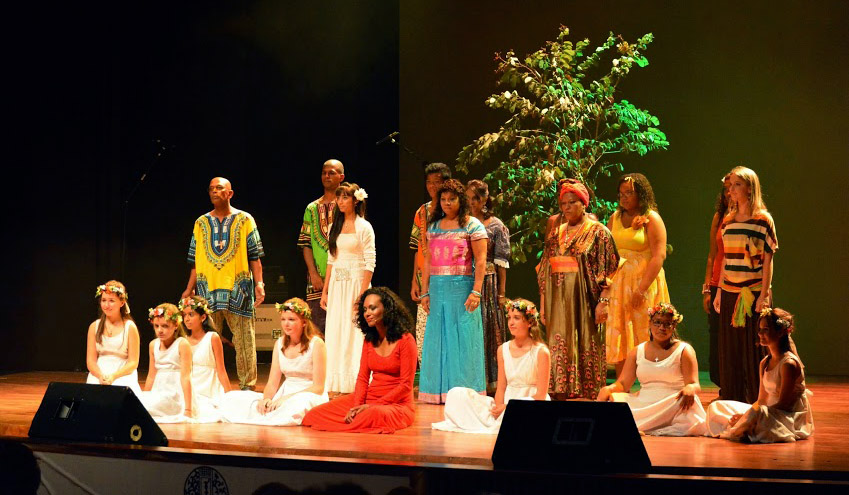

It all started in 2012 when Rev Patsy Mc Gregor was doing God’s work in Madagascar. She associated with two more women- Collete Maurel and Diane Watkins so that Miaraka (which means TOGETHER in Malagasy) could come to realization. But the story behind Miaraka is not as simple as a meeting between these godly sisters in Christ from different churches and is even much more complex than that. In fact, what is also amazing is the setting behind it. The initial reason of Miaraka was to sooth peoples in Madagascar mind after the cyclone Haruna hit them. Rev Patsy Mc Gregor went to her friend Collette and was like in a desperate need to calm the people with the use of her gifts, time and talents all given to her by God. They started by words which Patsy had in mind and which Collette translated into a song. Later on, they were able to write over 50 songs and this is how eventually Miaraka came to exist, through songs they had put together.
Back then they thought big and somehow Miaraka met their expectations. They spent a lot of dedication on the thinking and writing of Miaraka and the result was totally worth it. Miaraka was a project that took some time to be conceived, but in God’s timing there is no delay. Miaraka is one of those projects that did not stay idle, in fact the play was performed by Christians from different denominations not only in Madagascar but in Mauritius, South Africa and America and much more is to come.
What we should bear in mind is that Miaraka is not a simple play, it is far much more than that. The participants in the Miaraka project have proven to us that God’s work starts in the smallest and most sincere actions but is not limited to that. We could say that Miaraka represents the snowball effect. It comes from a single note of music and gets metamorphosed into a huge symphony. What is the most wonderful fact about Miaraka is that it’s a never ending process. It all started years ago but today we still hear about it. It’s in fact the perfect picture of the impact it had.
Today Miaraka is helping marginalized women all over Africa to become independent through the realization of an Eco-friendly activity. Through the confection and selling of fashion accessories made from re-used paper, the women are able to get a completely new life and feel part of something great: God’s work. Miaraka is in some way not only “a time to dance” but also a time for actions. The fact that it was written by 3 women in dedication to disregarded women is quite symbolical and brings much more impact to the representation. Just like in the play Mary was able to be loved and brought back to life by Jesus, these women are also able to get a new life in Christ and be accompanied in this new journey, leaving back their imprisoned ancient lives.
The focus should also be put on the story of Miaraka which is indeed a very beautiful one. The story of Miaraka is a new version of the story of Mary of Magdalena. Mary in the play is as in the original version a prostitute who finds herself drowned in her dark thoughts and thinks of suicide. Mary is left on her own and without any hope of better future. It is then that God intervenes in her life through her friend. She is then able to taste and see the real and true love, the love of God. But that is not the end, she is able to live her newborn faith among others and share what she experienced. Miaraka is no fairy tale, it may seem like one but it’s not. Miaraka is the story of so many Christians around the world. The play transmits so many emotions and the songs are also able to bring those emotions to words. Miaraka is also an act of worship and devotion to God, it is an experience to live, a walk with the Lord. The message that is transported through Miaraka is quite powerful. One of hope and union that we should all be able to function as one body in Christ and take care of the weak members of the body. That we should be able to come to God with all our failures and mistakes and repent before him. God takes care of the most broken and does delightful things through them. The play therefore invites us to come to him as a family with all our weaknesses.
Kathlyn Appadoo